Gardening in the ice and snow of Pennsylvania seems impossible until you try it in an unheated hoophouse. 2011 will be my third year of year-round gardening and this blog will be a journal and calendar of planting schedules, successes, failures and hopefully, a bountiful harvest.
MID-JUNE GARDEN
Friday, March 25, 2011
SALAD FROM MEXICO?!!
So, about our vacation in Nassau. We honeymooned in Nassau 40 years ago, and decided to go back to the scene of the crime for our anniversary. Of course, so much had changed since 1971, but the beautiful azure blue water was still as clear and brilliant as ever. The blooming flowers fell over walls and climbed up to the housetops. I didn’t see any agriculture but was told that indeed there are farms, which provide produce to the natives and the tourists. We gambled a little on Paradise Island, hung out on the beach and tried not to get sunburned, ate lots of seafood, walked for miles trying to see the ‘real’ Nassau, swam with the dolphins and was happy not to be in Pennsylvania where they were getting ice and snow. Actually, it was hard to come back to the colder weather, but when we got home I noticed that the daffodils were actually blooming and the irises in the fish pond were starting to grow, which is a sure sign of the approaching spring. The forsythia is on the verge of blooming and I think that after we get through this cold week, spring will be here. I hope so, otherwise, I might just head back to the Caribbean! While we were away, my son John took care of my vegetables on the windowsill, making sure to water them and turn them toward the sun. He did a good job and not only did they survive, but they thrived. The tomato plants are quickly outgrowing their space, and hopefully will be transplanted into the hoophouse in a week or two, weather permitting. I put the tomato and pepper plants into bigger pots and even sowed some impatience seeds and put them on the heat mat to germinate. Everything that is inside is doing well, and I am pleased with the success of my new growing rack that Ron made for me. It's a good design as it is very flexible. The hoophouses are bursting with greens, some newly seeded and some wintered over. We'll be eating salad from here on out - and NOT from Mexico!
Wednesday, March 16, 2011
GROWING TIMELINE AS OF MAR. 16, 2011
HOOPHOUSE: Swiss Chard (wo hh), Chinese Cabbage (wo hh), Spinach (wo hh), Lettuce (wo hh), Mesclun (wo hh), Lettuce ds hh 2/6), Mesclun (ds hh 2/6), Lettuce (ds hh 2/17), Mesclun (ds hh 2/17), Broccoli (T hh 3/1), Swiss Chard (T hh 3/1), Peas (ds hh 3/16), Chinese Cabbage (H 3/16)
GARDEN: garlic (wo), parsnips (H 3/1), peas (ds 3/16)
si = sown inside
ds = directly sown
wo = wintered over
hh = hoophouse
fc = fall crop
H = harvested
T = transplanted
B = bolted
Monday, March 14, 2011
MORE SNOW???
once again eating delicious salads from the garden. Last night I made a lettuce, mesclun and
spinach salad that had that intense flavor that only comes from the winter-overed greens. The Swiss chard and broccoli that I transplanted into the hoophouse doesn’t seem to be doing well and I may just direct seed into the garden. I should have done that to begin with, having learned that lesson from the year before. The lettuce that I sowed on February 17 is now blanketing the soil in
the hoophouse. These new greens will take us into the summer. My tomato plants (si 2/1) that are on the window sill are about 1’ tall and doing well. Only thing is, they are almost touching the grow light bulb and I need to reconfigure something to give them a little more head room. I have trays of all kinds of tomato plants – some for me and the rest to friend’s gardens. Any time they come to visit, they check out the tomato plant’s progress. Seems like everybody is getting anxious to plant!
Saturday, March 5, 2011
GROWING TIMELINE AS OF MAR 5, 2011
HOOPHOUSE: Swiss Chard (wo hh), Chinese Cabbage (wo hh), Spinach (wo hh), Lettuce (wo hh), Mesclun (wo hh), Lettuce ds hh 2/6), Mesclun (ds hh 2/6), Lettuce (ds hh 2/17), Mesclun (ds hh 2/17), Broccoli (T hh 3/1), Swiss Chard (T hh 3/1)
GARDEN: garlic (wo), parsnips (H 3/1)
si = sown inside
ds = directly sown
wo = wintered over
hh = hoophouse
fc = fall crop
H = harvested
T = transplanted
Thursday, March 3, 2011
WILD RED RASPBERRY WINE
Tuesday, March 1, 2011
LATE PARSNIPS -- OR ARE THEY EARLY?
Tuesday, February 22, 2011
GROWING TIMELINE AS OF FEB. 22, 2011
HOOPHOUSE: Swiss Chard (wo hh), Chinese Cabbage (wo hh), Spinach (wo hh), Lettuce (wo hh), Mesclun (wo hh), Lettuce ds hh 2/6), Mesclun (ds hh 2/6), Lettuce (ds hh 2/17), Mesclun (ds hh 2/17)
GARDEN: garlic (wo), parsnips (wo
si = sown inside
ds = directly sown
wo = wintered over
hh = hoophouse
fc = fall crop
WHAT IS SHE GROWING IN THERE?
The other day I planted some bulbs that my son Michael brought me from the Netherlands. He gave them to me at Christmas but the ground was frozen and I felt that I had missed my window of opportunity. But I kept them in the garage and when I peeked into the bag the other day, they were sprouting. Now what do I do? Well, I brought the deck boxes into the house to defrost and when they had warmed for a day or so, I planted all of the bulbs into the soft soil. This actually will probablyw ork out really well because the deer around here love tulips and would eat every single one, whereas they will be safe on the deck. It will be a pretty Easter this year with four boxes full of spring blooms. Maybe I'll transfer them all into a big pot on the deck so that every year we have a spring display. I never really got into forcing bulbs, but this may be a new gardening experience for me!
Tuesday, February 15, 2011
A WATCHED POT NEVER BOILS
Wednesday, February 9, 2011
GROWING TIMELINE AS OF 2/9/2011
INSIDE ON WINDOWSILL: Cherry tomatoes (si 2/1), Roma tomatoes (si 2/1), Beefsteak tomatoes (si 2/1), Broccoli (si 2/1), Swiss Chard (si 2/6), Peppers (si 2/8)
HOOPHOUSE: Swiss Chard (wo hh), Chinese Cabbage (wo hh), Spinach (wo hh), Lettuce (wo hh), Mesclun (wo hh), Lettuce (ds hh 2/6), Mesclun (ds hh 2/6)
OUTSIDE: garlic (wo)
si = sow inside
wo = wintered over
ds = direct sow
hh = hoophouse
THE BEGINNING OF THE MADNESS
I
guess I should tell you that I’ve been a gardener of sorts all of my life. In my childhood, I would sneak into the neighbors’ gardens and gather seeds from their Lady Slippers to plant in my mother’s small patch. My grandmother was a wonderful gardener, but was interested mostly in flowers, except for one very large peach tree in her Philadelphia enclosed garden. Now I know that I was small and all things look proportionally larger than when you grow up, but that one tree produced the most delicious largest peaches I ever ate. Any that were not eaten right off the tree would be canned and we would enjoy them in the strudels and pies that she would bake in her small linoleum kitchen. When I got married and moved into our first house, uninvited rhubarb sprouted from our backyard and I never really got used to that taste and finally dug it out. Over the years and in various houses, we had vegetable gardens of little success. It was usually a shady patch to blame, or the time constraints of raising a family. But nevertheless, we would always have a few obligatory tomato plants struggling to survive. And the small harvests from these plants provided a happy feast at the end of the summer. When we moved into our current house, I again planted a vegetable garden – under a canopy of towering poplar trees. Between the shade of the trees, and the wildlife living in this poplar forest, vegetable gardening became such a battle that I eventually replaced it with a wildflower shade garden. It wasn’t until a wind storm toppled some trees, opening up a hole in the canopy, that I decided to give it one more try. One more very serious try. So after spending a few weeks researching the internet and reading anything that I could find about raised bed gardening, I finally put three 4x8’ beds in. I filled them with compost and some manure from the horse up the street, leaves from the poplars and some garden soil to top it all off. I made a fence out of wildlife netting to keep out the critters and bought my seeds. Well, that first spring the garden got off to a great start until some varmint ate all the beautiful seedlings. Not only that, but I caught a squirrel red-handedly (paw?) chewing right threw the plastic netting. That’s when I went out and bought a metal fence and even though a squirrel could easily climb it, it deterred any additional nibbling. In fact, I was so paranoid, I put fences inside fences, inside fences and found that once the plants were pretty well established, and maybe because there were other things for the animals to eat, they left my garden alone. Once I made the hoophouse, the plastic could be replaced by netting making a very effective barrier. So I guess that there is always some problem – weather, animals, shade, blight – but that’s what keeps it all so interesting.
Sunday, February 6, 2011
SNOW SHOVELED MY WAY OUT TO THE HOOPHOUSE - IT'S GREEN IN THERE!
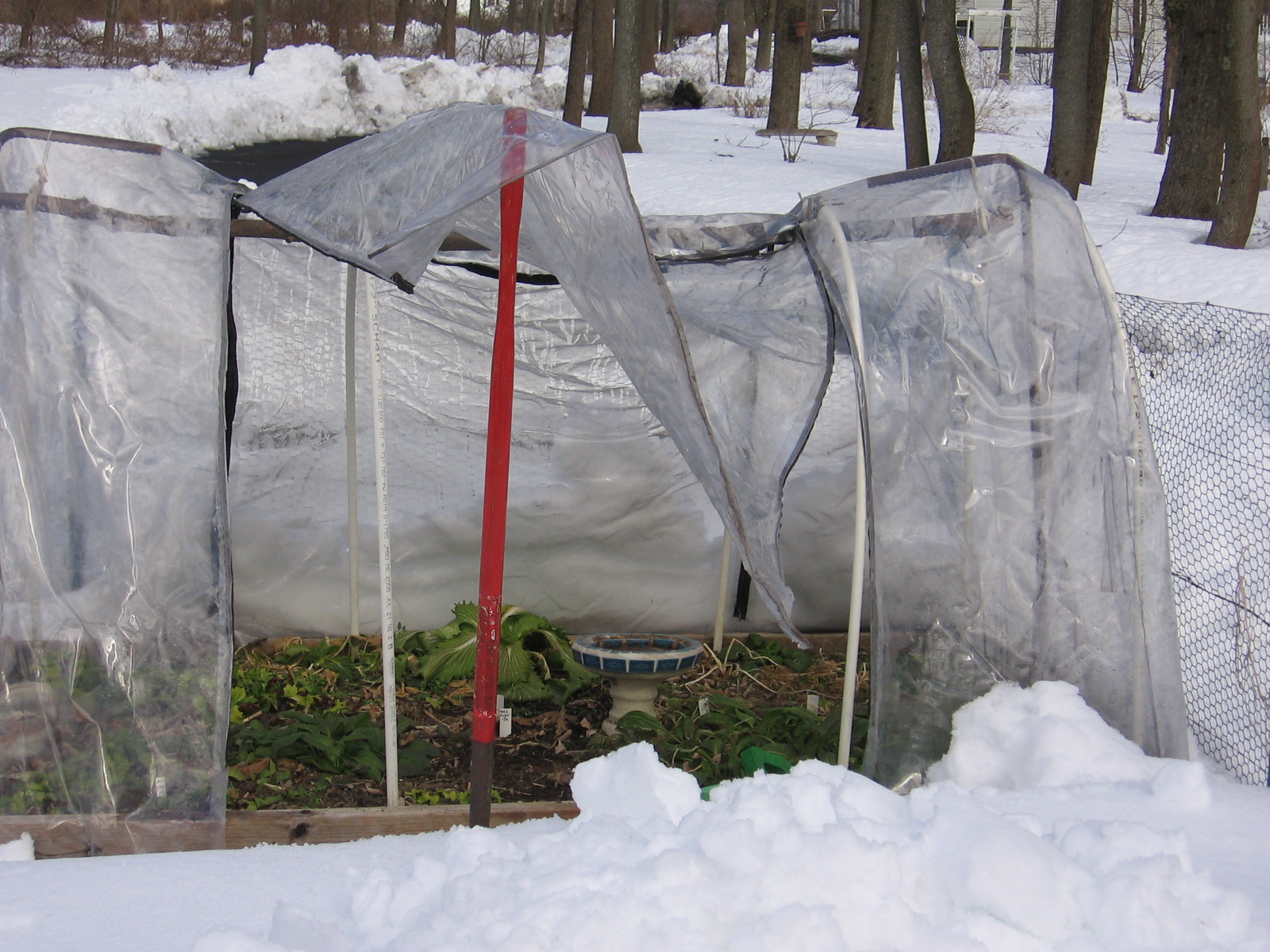
It’s 43° here in sunny Eastern Pennsylvania (~1 hour north of Philly) and it seemed like a perfect day to garden. Hubby Ron actually had to take the gate off the hinges so I could access the garden through the heavy snow and ice. Put on my snow boots and trudged out to the hoophouse wondering just what exactly I would find. Shoveled 1½’ of heavy snow to get to the zippered door and when I opened it up – ahhh, that wonderful smell of growth wafted out and made me anxious to plant. The soil was a warm 42° and the wintered-over crops (spinach, Chinese cabbage, lettuce, Swiss chard and mesclun) were growing out of the soft earth. In fact, if this heat wave keeps up, we’ll be eating salad from the garden in a week or two! I reached in to the hoophouse and did a little weeding, because of course, the weeds wintered-over too and then sowed a patch of mesclun and one of lettuce. Gave the garden a sprinkling of warm water and closed it up to keep the heat in. The hoophouse that has a domed roof seems to be surviving the harsh weather. The flat roofed hoophouse ripped a little and collapsed a bit under the weight of the snow, but considering that it both are in their 3rd winter, I think that my experimental sewn hoophouses are a success. The wintered-over crops in the flat hoophouse are surviving and starting to grow too, but I do think that the domed hoophouse is the smartest design in an area that gets snow and ice. A bigger hoophouse that would span 2 beds would be very cool since I could actually go into it on these February days and enjoy the aroma of spring two months early! Maybe that will be a future garden project – a bigger, plastic, sewn hoophouse.
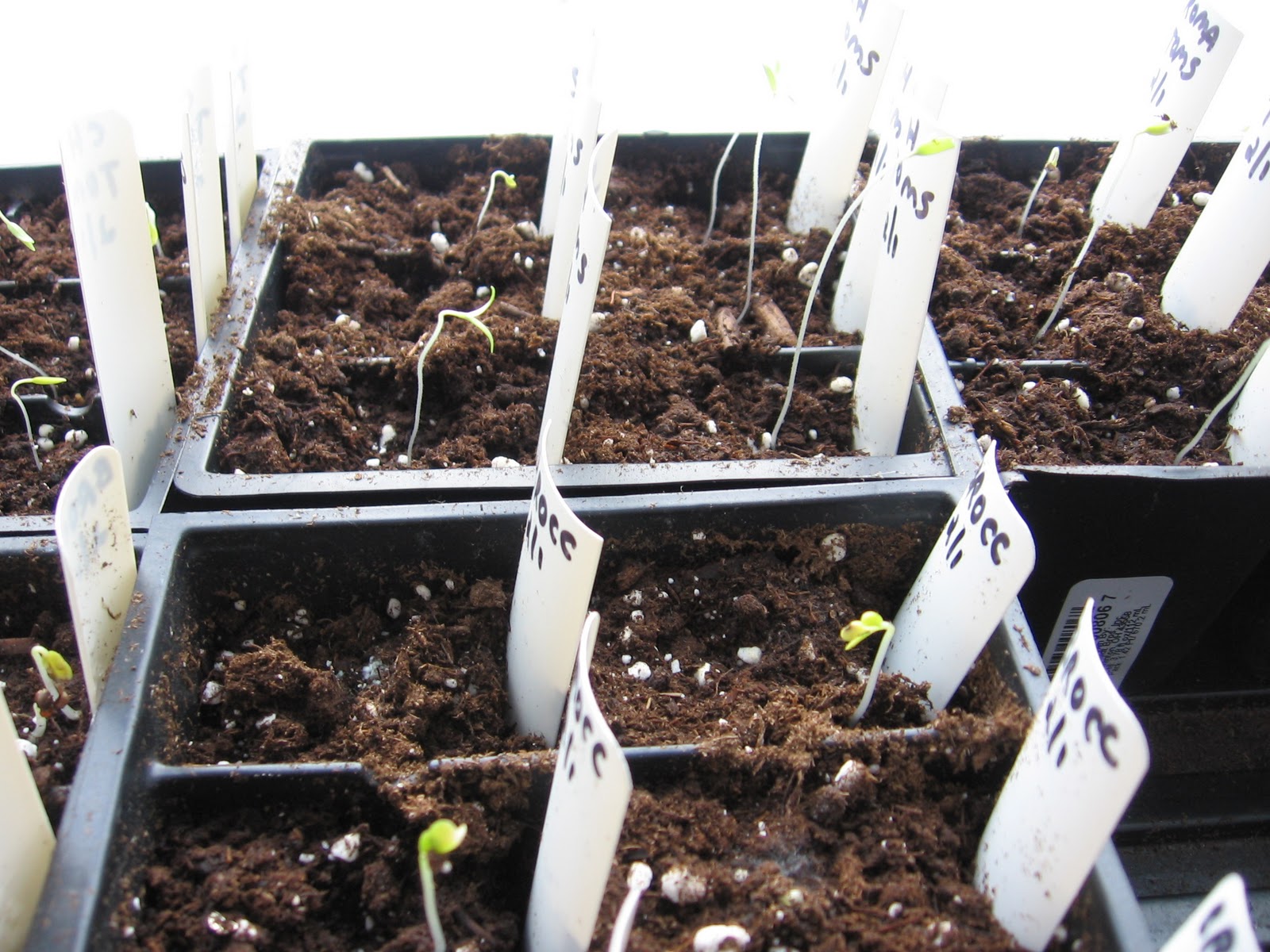
My inside plantings have germinated and I moved the tray of seedings (tomatoes and broccoli) onto my grow light rack by my picture window. Ron constructed a rack out of an old laundry room contraption, added a few grow lights and I am in business! I sowed some Swiss chard today down the basement and they are being kept warm on the heating mat.
GROWING TIMELINE:
INSIDE: Cherry tomatoes (2.1), roma tomatoes (2/1), beefsteak tomatoes (2/1), broccoli (2/1), Swiss chard (2/6)
OUTSIDE IN HOOPHOUSE: Swiss chard (wintered-over), Chinese Cabbage (wo), spinach (wo), lettuce (wo), mesclun (wo), lettuce (direct sow 2/6), mesclun (ds 2/6)
DIGGING AT LAST - kind of!?
Eventhough it is icing out, I sowed my early tomatoes (cherry, roma and beefsteak) and broccoli in small, sterilized cells down the basement. The 'seed starter' medium worked well last year, so I did the same for this year. They are all covered with a clear, plastic cover and set on a heating pad, since both tomatoes and broccoli like to be a bit warm (~75-80 degrees) when germinating. My tools were miniature - a toothpick and a flattened table fork. I watered everything with room temperature water from my outside fish pond - instant fertilizer! I marked my timeline, referring to 2010 and 2009, so I can chart the garden's progress. Last year at this time, I had already planted some of my greens in the hoophouse! It felt so good to finally be working in soil, getting my hands (actually my finger tips!) dirty and actually gardening. A huge ice and snow storm is supposed to hit here tonight and I am thinking that it might be sometime before I can dig my way to the hoophouses. I should have left the gate open before the gate got stuck closed. I'll mark that suggestion on next year's calendar.
WINTER SQUASH
Air Temp: 21° Hoophouse Soil Temp: 35° - not quite frozen
I suppose that you can’t be a serious gardener without being a serious eater! And if you love to eat, you love to eat even more if it is fresh from your own garden. What could be more satisfying, more fulfilling, than to cook with your very own produce. How much more local can you get than from your own backyard? But after one successful year with my raised beds, I bought seeds for vegetables that had previously been taboo. I never, ever grew butternut squash before this last year. In fact, I never grew any other squash than zucchini. Maybe after growing that prolific vegetable, which turns into a baseball bat-sized monstrosity when left too long on the vine, I was actually afraid that all squash would be potential giants – almost like Woody Allen’s giant vegetables. But last spring for some unknown reason, I found some butternut squash seeds at my local Agway and planted a few seeds along my fence. It turned out to be a very good idea as those small seedlings grew into long vines with about 12 squash. Since I trained them on the fence, they took up very little garden space and even inadvertently provided a little shade during our very hot July. I even crocheted little hammocks for each squash which gently supported each as they grew. This proved to be unnecessary as I found that butternut squash had very strong stems. But my crafting friends thought it a funny, creative touch to my garden. So at the end of the growing season, I had 12 butternut squashes in the basement storeroom waiting for winter soup. I found this excellent recipe on the internet and recommend it highly with fresh baked bread and winter greens. Enjoy!
Butternut Squash Soup with Apple & Bacon
8 slices bacon, cut crosswise into 1/4-inch strips
2-1/2 lb. butternut squash (about 1 medium), peeled, seeded, and cut into
1/2-inch dice (to yield about 6 cups)
1 small Granny Smith or other tart-sweet apple, peeled, cored, and cut into
1/2-inch dice (to yield about 1 cup)
1-1/2 Tbs. finely chopped fresh sage leaves
1 tsp. kosher salt
1/2 tsp. freshly ground black pepper
4 cups homemade or low-salt chicken or vegetable broth
In a 5-quart or larger stockpot set over medium heat, cook the bacon, stirring occasionally, until crisp and golden, 8 to 10 minutes. Use a slotted spoon to transfer the bacon to a plate lined with paper towels.
Increase heat to medium high. Add the squash to the pot with the bacon fat and cook until lightly browned, 4 to 6 minutes (resist the urge to stir it too often or it won’t brown). Stir in the apple, sage, salt, and pepper and cook for about 4 minutes (you’ll see more browning occur on the bottom of the pot than on the vegetables). Add the broth, scraping up any browned bits in the pot with a wooden spoon. Bring to a boil over high heat, reduce the heat to maintain a simmer, and cook until the squash and apples are very soft, 6 to 8 minutes. Remove from the heat and let cool somewhat.
Add about half the bacon to the soup and purée, using a stand or immersion blender (you’ll need to work in batches if using a stand blender). Taste and add more salt and pepper if needed. Reheat the soup and garnish each serving with the remaining bacon.
Thursday, January 27, 2011
ANOTHER 18" OF SNOW!!
Sunday, January 23, 2011
JANUARY GARDENING
Gardeners generally hibernate in the cold months of the year, sharpening tools and paging through seed catalogues. Not me! My growing season starts in January, in the hoophouse and on my windowsill. In 2009, I sewed a hoophouse as an experiment in an effort to extend my growing season. There is lots of information out there about constructing a hoophouse, but I haven't heard of anyone using a home sewing machine to make one! My hoophouse is constructed over a 4' x 8' raised bed, using PVC pipe on 3' rebar for support. I purchased 12 yards of 12 ml plastic and (6) 48" sports zippers from a fabric store. First, I sewed 2 11' lengths of plastic together. Two zippers were sewn 1' from each end. And 2 other zippers were sewn across the top. I used separating zippers so that it could be unzipped from the top for ventilation or from the bottom to access to the bed. Each 'door panel' could be removed using the zippers. I then cut 2 end panels to fit, using a bent PVC pipe as a pattern. I also attached a pocket to the middle of each of these. These pockets hold 5' rebar rods, which when pounded into the earth, keep your hoophouse from blowing away! I also put grommets around the edges of the entire hoophouse which were secured into the wooden raised bed frame with screws. I also constructed a flat-topped version of this, but think that the round-top hoophouse works best. Both structures are in their third winter and except for some minor repairs, still serviceable. Not bad considering that on March 13, 2010, a Nor'easter blew in with 50 mph winds! I know of other people who drape plastic over the PVC and weigh down the edges with bricks or wood. One year I successfully used up-side-down clear storage boxes to winter over my spinach, which, in fact, led me to using a hoophouse. The successes of that first experiment encouraged me to continue my undercover gardening and create this blog. In January, if I've planned well and am lucky, I harvest any wintered-over crops, usually greens such as mesclun.
The flavorful lettuces and various greens are worth digging a path through the snow and braving the cold Pennsylvania temperatures. This year, on January 5, I harvested fresh winter salad and served it with cold storage butternut squash soup. It was awesome and set me to dreaming about my next garden. Lately though, it's been very cold and the garden is at a standstill, waiting for the sun to warm. January for me is usually spent gathering seed packets at Agway, rather than ordering from the catalogues. I don't want to have to wait even one day to smell those seeds and I love holding those colorful packets in my hands when January is throwing her worst weather at us. My first purchase is always 'mesclun' as it does well in a cold hoophouse. That being said, I plan to plant mesclun in the hoophouse as soon as I can open the garden gate, which right now, is totally blocked by snow. My flat-topped hoophouse is outside the gate and may be my only option. I will put my thermometer in there and chart the soil temperature for a few days. It's so hard not to jump the gun and plant too early, although mesclun usually bides it's time in the cold soil until the temperatures warm a bit for germination. A soil thermometer presents me with the cold hard facts of January and I rely on mine for guidance. Tonight, air temps are in the low 20s, and although the soil in the hoophouse is not frozen, the surviving greens are wilted. I find that there is generally a 15 degree difference, and 35 degrees is a little too cold even for germinating mesclun. I guess for now, my only option is to be patient and strap on those cross-country skis!